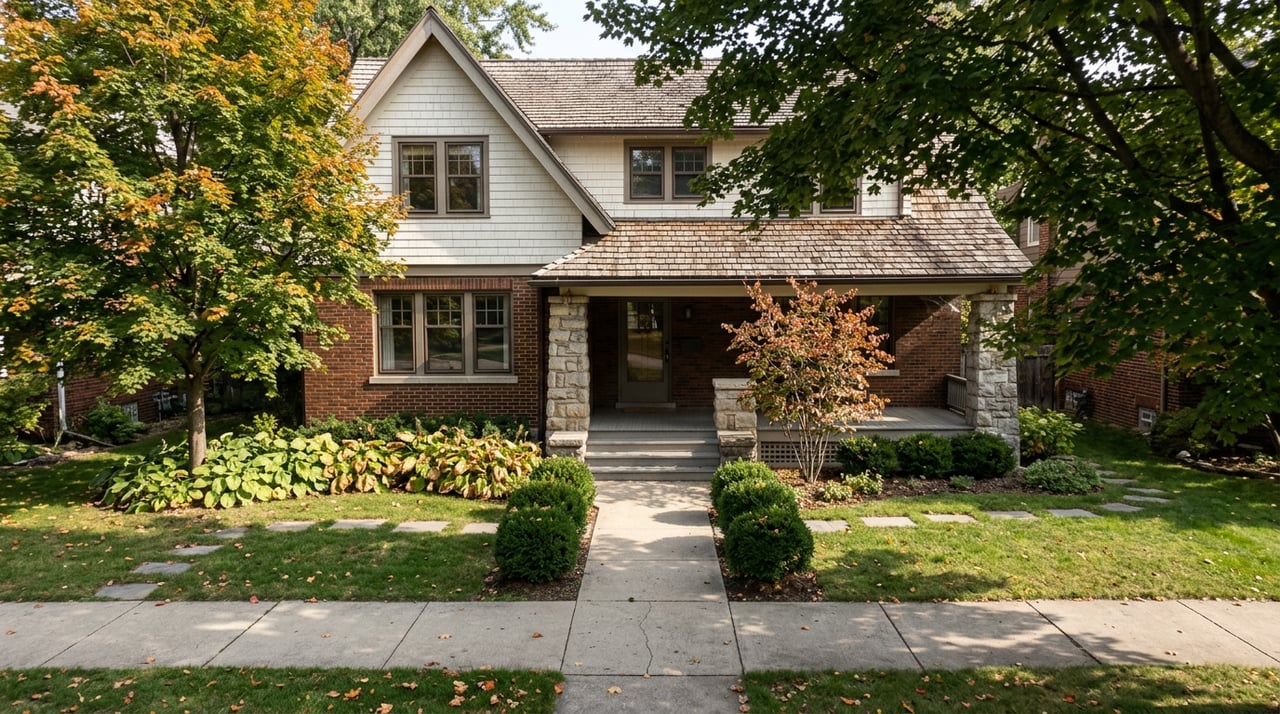
St. Paul Doesn't Have One Housing Market. It Has Four.
September 10, 2026
September 10, 2026
Ask what a house costs in St. Paul this summer and you'll get an answer that sounds precise and means almost nothing. Redfin puts the citywide median at $304,000 for the three months ending May 2026, down almost 2 percent from a year earlier. Houzeo's read on the same city, same season, lands at $269,000. Neither number is wrong. Both are averaging together neighborhoods that have nothing in common except a shared zip code prefix.
Summit Hill and Summit University sit back to back along the same stretch of Summit Avenue. In the spring of 2026, homes in Summit Hill were selling for an average of $793,000 and sitting on the market for 74 days before closing. Summit University homes, in the same week, were moving in 43 days for an average of $424,000. That's not noise. That's two different economies operating under one city name, and a buyer who anchors to the citywide median before touring either neighborhood is going to be wrong by a margin that matters.
Start with the discrepancy itself, because it's instructive. Redfin's citywide figure and Houzeo's citywide figure differ by $35,000, and both are describing the same market in the same rough window. That gap exists because St. Paul's housing stock is genuinely bimodal: condos averaging around $180,000 sit in the same dataset as single-family homes averaging north of $400,000, and depending on how a given source weights recent sales, the blended number swings.
That instability gets worse, not better, once you zoom into individual neighborhoods. Summit Hill is the clearest case. Redfin's own numbers, pulled in August 2026, show the neighborhood's median sale price over the three months ending June 2026 at $510,000, down 16 percent year over year, while July's single-month average sat at $421,000, down 7 percent. A different market read, based on a rolling 12-month median rather than a quarterly one, put Summit Hill's figure at $657,500, up 22 percent from the prior 12 months. Three legitimate ways to measure the same neighborhood produced three different directions of travel.
The explanation isn't fraud or bad data. It's sample size. Only 34 homes sold in Summit Hill in June 2026, matching the prior year exactly. When a neighborhood's monthly transaction count is that small, one estate sale or one distressed listing can swing the median by six figures. A buyer reading a single month's Summit Hill number as a trend is reading statistical noise as signal.
Here's how the picture settles once you separate the neighborhoods that get lumped into "St. Paul" on a portal search:
| Neighborhood | Price signal | Days on market | What it tells a buyer |
|---|---|---|---|
| Summit Hill | ~$510K median (3 months ending June 2026), volatile between measurement windows | 19-21 days | Small, historic, high-variance. One or two sales move the whole number. |
| Macalester-Groveland | ~$555K average (spring 2026 weekly snapshot), selling at 102% of list | 22 days | Fast and consistent. Buyers compete for what's listed. |
| Highland Park | ~$450K median, up 0.6% year over year (early 2026) | 28 days | Steady seller's market. Homes close near asking with little room to negotiate. |
| Summit University | ~$424K average (spring 2026 snapshot), selling at 102% of list | 43 days | The slower, more accessible entry point into the city's established core. |
Four neighborhoods, four different clocks. Highland Park sellers aren't leaving money on the table waiting for a better offer, they're getting full price in about a month. Summit Hill sellers see the widest swings of the four, sometimes closing quickly and sometimes waiting more than two months, because the neighborhood's small transaction count means each individual sale carries outsized weight. Mac-Groveland's pace holds steady no matter which reading of the data you check, and that consistency isn't random.
Mac-Groveland's pace traces directly to Grand Avenue, the 26-block commercial corridor that runs through the neighborhood's center. It's not a strip of chain retail. It's the kind of walkable stretch of longstanding cafes and independent shops that gives a neighborhood a reason to compete for, and once a year it becomes the site of Grand Old Day, the largest free one-day street festival in the Midwest, held the first Sunday in June. A buyer touring Mac-Groveland in spring is touring a neighborhood mid-preparation for the biggest civic event on its calendar. That's the kind of texture a median price can't capture but a 22-day close time reflects perfectly: buyers here aren't debating whether the neighborhood works, they're debating whether they can move fast enough to get one of the houses that comes up.
Highland Park's steadiness has a different explanation, and it's changing in real time. Part of the neighborhood is being rebuilt right now as Highland Bridge, the redevelopment of the 135-acre site where Ford's Twin Cities Assembly Plant operated until it closed in 2011. Ryan Companies has been master developer since 2018 and bought the land in December 2019. Construction started in 2020, then stalled from 2022 to 2025 as construction costs, financing difficulties, and the city's rent control ordinance stacked up against the project.
That stall ended in May 2025, when the City of Saint Paul amended the developer agreements to unlock financing and commit builders to 447 new housing units across three multifamily buildings, plus four new commercial buildings totaling 36,500 square feet of retail. By May 2026, planning commissioners were reviewing real progress: a 97-unit mixed-use building along Ford Parkway with three commercial retail buildings and a daycare tenant, all targeted for completion by the end of the year, according to reporting from MinnPost's Documenters project. Developer Sean Ryan told the city's Housing and Redevelopment Authority the gateway building remains on track for an October 2026 turnover, and the project's next phase, a 175-unit building called Block 11, was set to begin construction in summer 2026 with occupancy expected in winter 2027 or 2028, per coverage in Twin Cities Business. Pulte Homes is separately finishing 167 rowhomes on the site, targeted for late 2026 or early 2027.
None of that shows up in Highland Park's median sale price yet. New construction on Highland Bridge parcels gets counted separately from resale activity in the surrounding blocks, so a buyer comparing Highland Park's steady $450,000 median against a new Highland Bridge listing is comparing two different products inside the same walk radius. Over the next 18 months, as roughly 2,600 to 2,800 total residential units come online in phases, that adjacent supply is likely to shape how much negotiating room resale buyers get in Highland Park proper, even though the resale numbers won't say so directly.
None of this means the citywide median is useless. It's a reasonable starting point for someone who hasn't picked a neighborhood yet. But once you know where you want to live, the citywide number stops being information and starts being a distraction. The question isn't "what does a home cost in St. Paul." It's "what does a home cost in the specific three or four blocks I keep returning to, and how long do sellers there typically wait before they get their price."
If you're comparing Highland Park to Mac-Groveland, you're not choosing between two similar markets at different price points. You're choosing between a steady, low-negotiation market next to a construction zone that will reshape its supply over the next two years, and a fast, competitive market anchored to a commercial strip that draws people in on its own. Summit Hill is a different conversation entirely, one where the small number of annual sales means your specific house, not the neighborhood average, will determine your outcome.
Is St. Paul's citywide median home price a reliable number to budget around? Only as a rough starting point before you've chosen a neighborhood. Once you know where you want to buy, the citywide figure stops reflecting your actual competition, since it blends condos averaging under $200,000 with single-family homes in neighborhoods like Summit Hill selling well above $500,000.
Why do home prices in nearby St. Paul neighborhoods move in opposite directions? Partly it's genuine difference in buyer demand and housing stock. Partly it's sample size. Neighborhoods with only 30 to 50 sales a month, like Summit Hill, can show a median swinging in different directions depending on whether you measure a single month or a trailing year, because a handful of sales carry outsized weight.
Will the Highland Bridge development affect resale prices in Highland Park? It's already reshaping the supply picture inside the neighborhood, with roughly 2,600 to 2,800 units expected in phases through 2028. That new construction is counted separately from Highland Park resale data for now, but as those units come online, they're likely to affect how much negotiating leverage resale buyers and sellers have in the surrounding blocks.
If you're weighing Highland Park against Mac-Groveland, or trying to figure out whether a Summit Hill listing is priced against last month's outlier sale or a real trend, that's exactly the kind of block-by-block read that doesn't show up on a portal search. Kary Marpe has spent decades reading these St. Paul micro-markets one neighborhood at a time. Let's connect, call or email today, and figure out which St. Paul you're actually buying into.
Stay up to date on the latest real estate trends.
I am always here for personal service by phone or email, so feel free to contact me any time!